Vietnam Real Estate Investment: A Systematic Approach to Strategy Selection
Most investors entering the Vietnam real estate market yield results below expectations—not because they selected the wrong market, and not because they entered at the wrong time.
The issue arises earlier: at the stage when the source of yield has not yet been defined, but the purchase decision has already been made.
Vietnam is not a single market with a single cycle. It is a system of intersecting capital flows, urbanization stages, and value formation mechanisms. Different territories monetize different forms of demand. And a strategy that works in one segment may fail in another—even if both properties are located in the same city.
In this article, we explain how the Vietnam real estate market is structured from an investor's perspective, the decision-making framework we use at VINPROP, and the five strategies that form the core of our capital management. Each strategy is analyzed in a separate article; here, we cover the selection logic and what sets one strategy apart from another.
Why Vietnam: Macro Context for the Foreign Investor

Vietnam is one of the few global economies sustaining a steady growth of 6–7% GDP per year over two decades. Behind this are not natural resources or a one-off surge, but structural processes unfolding consistently over the long term.
First process — Industrialization.
Vietnam has become a primary beneficiary of manufacturing relocation from China. Samsung, Intel, LG, Nike, and Foxconn have all established major industrial clusters here. Foreign direct investment (FDI) inflows exceed $18 billion annually and continue to grow. Industry creates jobs, jobs generate income, and income drives housing demand.
Second process — Urbanization.
In 2000, roughly 25% of Vietnam's population lived in cities. Today, that number exceeds 40%. By 2030, this figure is projected to surpass 50%. This signals sustained, multi-year structural demand for urban housing—not speculative, but real: people need places to live.
Third process — Middle-class growth.
The country's population stands at 97 million people, with a median age of around 31. According to Boston Consulting Group, Vietnam's middle class will double by 2030. This expands the domestic market, increases mortgage demand, and raises standards for housing quality.
For the real estate market, this implies one thing: Vietnam is in a phase where structural drivers generate long-term demand rather than short-term hype. This is precisely why investment strategies based on fundamental growth drivers—rather than luck or timing—work here.
Legal Framework for Foreign Investors
The 2015 Housing Law opened the market to foreign nationals. Foreigners can own residential property on a 50-year leasehold basis with the option to renew. Ownership rights are certified by a "Pink Book"—a state document granting rights to resell, lease, and inherit.
Restriction: No more than 30% of units in a single condominium building can be foreign-owned.
VAT on Purchase: 10% of the transaction value.
Tax on Sale: 2% of the sale amount.
You can find a detailed guide on buying real estate in Vietnam here.
This is not an exotic destination with unclear rules. It is a mature market with clear regulations that has yet to complete its full revaluation cycle.
Why Now: The 2025–2026 Window of Opportunity
Investors who entered Vietnam in 2015–2019 achieved the highest returns: the market was at the beginning of a new cycle back then. Does this mean it is too late now?
No. But the underlying logic has evolved.
In 2025–2026, the Vietnam real estate market is going through several simultaneous developments. The government is implementing a massive infrastructure program: ring roads around Ho Chi Minh City, metro expansions, and the new Long Thanh International Airport. Administrative reforms are transforming the value map—several provinces are gaining new statuses and functions. The market is recovering after the 2022–2023 lull, when regulatory tightening temporarily slowed activity.
All this creates a specific window: areas at the start of their infrastructure cycle remain undervalued by the market. Developers are launching new project phases at initial prices that do not yet reflect the future urban function of the location.
However, this window is not indefinite. As infrastructure projects advance, entry prices rise. The difference between "entering now" and "entering in three years" lies in who captures the revaluation yield.
Why Vietnam Real Estate Investments Don't Always Deliver Expected Results
Investors who underperform generally commit one of several common mistakes.
- Purchasing an asset without a pre-defined source of yield. The investor bought "in Vietnam"—without understanding what specific factor would drive capital appreciation for that property.
- Betting on infrastructure growth without analyzing whether real demand exists to support it.
- Overestimating rental projections without analyzing location fundamentals and operational models.
- Mismatched investment horizons—expecting quick gains from a strategy that is inherently long-term.
The core issue behind all these mistakes is the same: asset selection became the starting point rather than the result of a strategy.
The real estate market in Vietnam is becoming increasingly segmented. Infrastructure, urbanization, industrial growth, and tourism flows form distinct sources of return across different locations. In a segmented market, investment outcomes depend less on general market direction—and far more on precise capital positioning.
Market access alone does not generate investment performance.
How to Make Decisions: A Six-Step System
We apply a structured framework. Skipping any step doesn't simplify the process—it increases unmanaged risk.
Step 1. Market Cycle Phase. Where is the market currently in its cycle? This establishes the macroeconomic context for all subsequent decisions.
Step 2. Capital Flows. What specifically drives demand in this segment? Industrial capital creates one type of demand, tourism another, and concentrated commercial activity a third. Each source follows its own pricing logic, liquidity dynamics, and yield drivers. Misunderstanding capital flows leads to selecting a strategy misaligned with actual demand drivers.
Step 3. Source of Yield. What creates value in this segment: land revaluation, rising household incomes, supply deficit, or liquidity concentration? These are distinct mechanisms requiring different execution strategies.
Step 4. Strategy Selection. Which strategy captures the identified source of yield most effectively under current market conditions?
Step 5. Capital Allocation. Target capital volume, investment horizon, and structural breakdown. These decisions are made within an already defined strategy.
Step 6. Asset Selection. Only at this stage does selecting specific properties begin—within a pre-determined investment space.
Asset selection is the output of a strategy, not its foundation.
5 Investment Strategies for Vietnam Real Estate
The current market structure shapes five dominant strategies. Each results from a specific combination of capital flows, demand dynamics, and liquidity conditions. They do not compete with one another: they are distinct instruments for different investment objectives and risk profiles.
Strategy 1. Structural Growth

Vietnam continues its active phase of industrialization. Foreign Direct Investment creates manufacturing hubs, hubs generate jobs, employment increases household income, income enables mortgage access—and together, this creates steady end-user demand for housing.
The Structural Growth strategy taps directly into this cycle.
Its objective is positioning in locations where industrial growth outpaces housing supply, before the market fully recognizes the demand-supply gap.
Key feature: Yields here are driven by actual end-user absorption rather than speculative investor demand. This makes outcomes more predictable and less susceptible to market sentiment shifts.
Key selection criteria: Proximity to major employment hubs, pricing aligned with local incomes, high proportion of end-users, proven sales velocity in previous project phases.
Horizon — Short to medium term.
Risk: If employment growth or wage gains slow down, the yield driver weakens.
Strategy 2. Urban Cluster Capitalization

Urban value is dynamic. As metropolitan areas expand, established centers face congestion, infrastructure connects new areas, and new hubs of value emerge on the periphery. An area perceived as a "suburb" three years ago evolves into a new urban center.
Urban Cluster Capitalization Strategy involves early entry into a location undergoing this structural shift. The investor enters at a price point that does not yet reflect the future urban function. Yield is generated as prices in the new cluster converge toward those of established districts.
Mechanism: Transport accessibility → Urban function development → Demand & capital concentration → Deepening liquidity → Price convergence with core centers.
Key criteria: Proximity to committed infrastructure projects, signs of emerging liquidity (rapid sales in initial phases), developer capable of creating a comprehensive urban ecosystem. Note: This strategy is not for areas with only promised infrastructure—construction must already be underway.
Horizon — Long term.
Potential — Highest among the five strategies.
Risk: Delays in infrastructure projects postpone asset revaluation.
→ How to identify the right transformation point. Case Study Vinhomes Grand Park: 5.6x equity multiple
Strategy 3. Hospitality Deficit

Resort markets operate on a different demand framework. The primary driver is international tourist arrivals, while the supply of prime assets remains constrained by geography, regulatory limits, and infrastructure deployment speed. This structural deficit sustains property value regardless of local real estate cycles.
The Hospitality Deficit strategy focuses on investing in professionally managed, hotel-grade residential assets in high-appeal international tourist destinations.
Yield consists of two revenue streams: ongoing rental yield (ADR × Occupancy) and long-term asset appreciation as the destination matures.
Hallmarks of a prime location for this strategy: Sustained international demand drivers, limited prime waterfront supply, presence of branded operators with proven operating models, and infrastructure that encourages multi-night stays rather than transit visits.
Key risk — Operational: If the destination fails to build consistent international visitor volume, rental yields may fall short of projections. This makes selecting a mature location far more critical than betting on a "future Bali."
→ Hospitality Deficit Strategy: Phu Quoc, branded management models, Regent Phu Quoc case study
Strategy 4. Capital Concentration

Capital distribution is uneven. It consolidates where business activity, administrative authority, and decision-making concentrate—and where high-grade supply is structurally constrained. These locations develop the deepest market liquidity.
The Capital Concentration strategy prioritizes capital preservation backed by a liquidity premium and pricing resilience over aggressive growth. For investors with lower risk tolerance—or those needing predictable exit strategies—this serves as the core logic.
What matters in this strategy: Not just "city center" status, but physical proximity to key institutional anchors—banks, corporate headquarters, government institutions. These anchors drive steady business demand that supports liquidity across all market cycles. High entry barriers for new supply (land scarcity, complex permitting) safeguard pricing power.
Horizon — Medium term.
Risk: During broader economic slowdowns, liquidity premiums may temporarily compress, though institutional districts historically rebound faster than other market segments.
Strategy 5. Lifestyle

As personal incomes rise, housing choices expand beyond basic affordability. Urban design quality, lifestyle convenience, access to dining, parks, co-working spaces, and healthcare increasingly guide buying and long-term rental decisions. Real estate becomes an extension of lifestyle.
The Lifestyle strategy leverages middle-class expansion, internal migration of skilled professionals, and an influx of expats and digital nomads. Yield is generated through two paths: capital appreciation as the area gains appeal and stable rental income from high-income long-term residents.
Core differentiator: Demand here comes from people who want to live in the community—not investors seeking a quick resale. This makes lifestyle-grade properties more resilient during market downturns: even when investor activity slows, end-user residential demand persists.
Criteria: Cities with diversified and expanding economies (not single-industry hubs), developments with high-quality architecture and professional management, limited segment supply, and proven long-term rental growth.
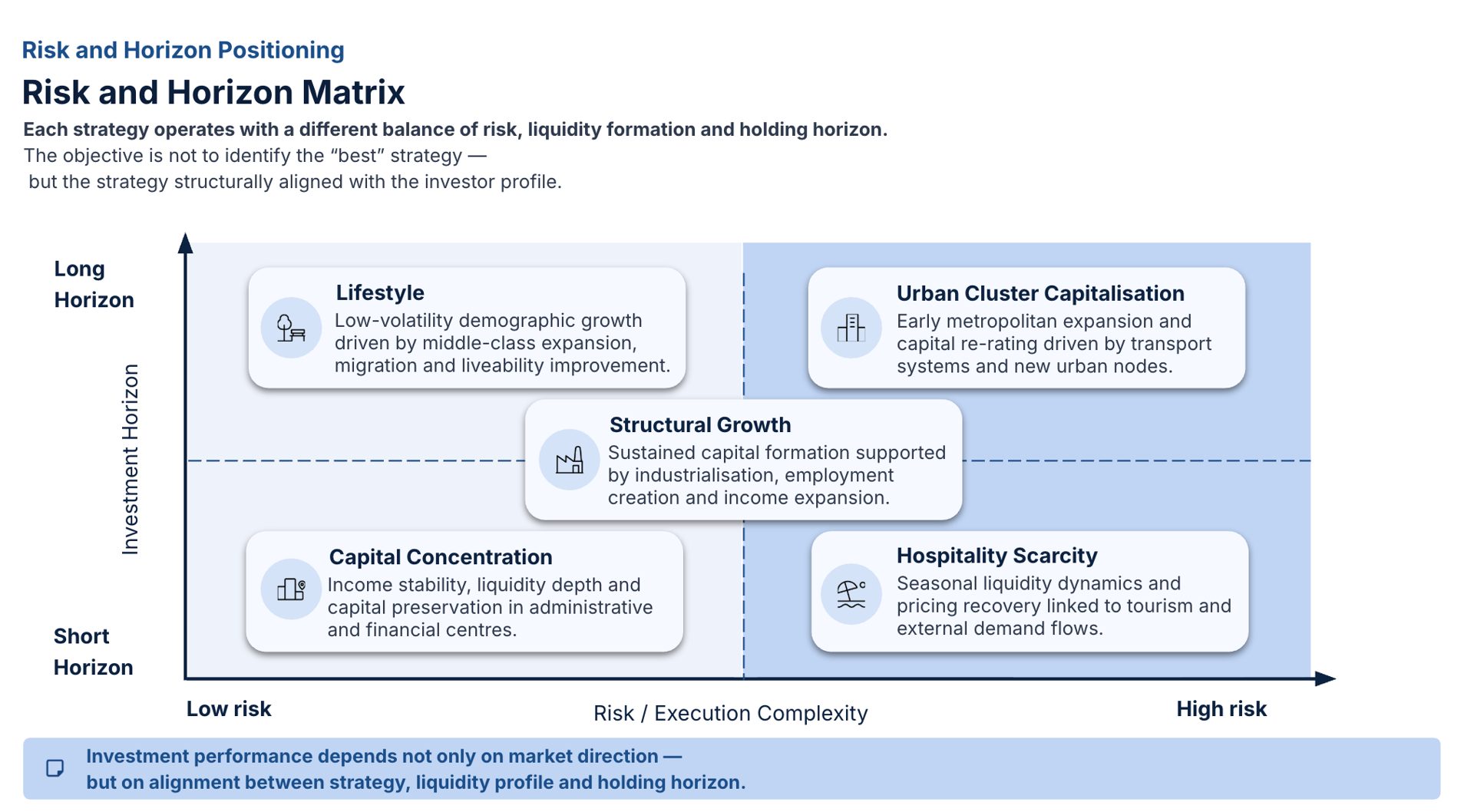
How to Choose a Strategy: Risk vs. Horizon Matrix
The right strategy isn't the one showing the highest theoretical yield on paper. It is the strategy aligned with your objectives, timeline, and risk profile.
Four core parameters determine your choice:
- Investment Objective. Some investors prioritize capital appreciation, others look for recurring income, while some focus on capital preservation combined with liquidity. Each objective requires a specific yield mechanism.
- Risk Tolerance. The Cluster Capitalization strategy carries higher risk than Capital Concentration—and correspondingly higher upside. Investors must evaluate what level of uncertainty they can comfortably manage financially and psychologically.
- Investment Horizon. Every strategy requires a minimum timeframe to fully execute its value creation process. An investor seeking an exit within 2–3 years should avoid long-horizon strategies like Cluster Capitalization.
- Liquidity Requirements. How quickly and predictably must the asset convert back into cash? Capital Concentration in prime institutional hubs provides the highest liquidity, while resort assets generally offer lower liquidity.
How to Buy Property in Vietnam: A Practical Guide for Foreigners
Buying property in Vietnam as a foreigner is straightforward with proper advisory guidance.
The purchase process follows these steps:
- Property selection and reservation agreement signing (booking fee is typically 1–5% of the purchase price).
- Signing the Sale and Purchase Agreement (SPA), establishing all transaction terms and the payment schedule.
- Staged installment payments according to the developer's schedule—primary market purchases usually involve several tranches throughout construction.
- Upon completion and handover, property title registration takes place to issue the "Pink Book".
Funds are wired directly to a Vietnamese bank account. Opening a bank account for foreigners is a routine process completed within a few hours. All transactions are routed officially via banks, ensuring full legal compliance.
Taxes and Purchase Fees: Registration fee — 2% of asset value, notary and legal processing fees — approx. 0.5%.
On Sale: 2% personal income tax on the total sale price (withheld at source).
Foreign investors can grant Power of Attorney (POA) to a legal representative in Vietnam, enabling remote completion without requiring physical presence at every step.
Important note: The 30% foreign quota limit per building means foreign-eligible units in prime developments sell out quickly. This highlights the advantage of securing units early during launch phases.
Risks of Real Estate Investment in Vietnam
Objective market analysis addresses potential risks proactively.
Regulatory Risk. Foreign ownership regulations can evolve over time. The 2015 Housing Law established clear guidelines, extended further in 2023. Nevertheless, investors should stay informed on legislative updates and work with specialized legal counsel.
Currency Risk. Property transactions and valuations operate in Vietnamese Dong (VND). Historically, the Dong undergoes gradual, controlled depreciation against the USD—averaging 2–3% annually. This factor must be integrated into USD return projections.
Developer Risk. Construction delays and quality variance occur in emerging markets. Working with established international developers with strong track records mitigates this risk. Rapid sales velocity in previous project phases offers a reliable indicator of execution capability.
Liquidity Risk. Real estate remains an illiquid asset class relative to equities. Niche markets (luxury resort properties, ultra-high-end units) may require longer exit timelines. Your exit strategy and timeline should account for this from the start.
Market Cycles. Even high-growth structural markets experience temporary lulls and adjustments. Your investment horizon should allow you to hold through cyclical dips comfortably without forcing a discounted exit.
Key takeaway: Most risks can be effectively managed through proper strategy, developer selection, and timeline planning. In Vietnam, selecting the "wrong strategy" presents a far greater risk than selecting the "wrong market."
A Portfolio Approach
While each of the five strategies functions independently, VINPROP designs portfolio solutions for institutional and high-net-worth investors—combining multiple yield drivers within a unified investment structure.
The goal isn't diversification for its own sake, but building an investment structure where strategies leverage different demand drivers, liquidity profiles, and growth cycles.
Example: Capital Concentration as a stability anchor + Structural Growth as the core growth engine + Cluster Capitalization as a tactical upside driver.
This framework minimizes market sensitivity across individual segments while preserving access to high-yielding growth opportunities through calculated allocations.
How We Work
VINPROP doesn't just sell property. We structure comprehensive real estate investment solutions across Vietnam.
We begin by defining your investment goals, timeline, risk limits, and liquidity preferences. From there, we identify the optimal strategy and target segment, curate a shortlist of compliant projects, and verify alignment with your investment logic. Finally, we handle end-to-end execution across acquisition, asset management, and exit positioning.
Strategy defines direction. Execution determines performance. Discipline ensures long-term consistency.
FAQ
How do the five strategies compare in risk level?
Low Risk — Capital Concentration: Built on institutional demand and deep liquidity in established business districts.
Moderate Risk — Lifestyle and Hospitality Deficit: Offers predictable returns tied to operational management quality.
Above Average Risk — Structural Growth and Cluster Capitalization: Higher upside potential, but yield execution relies heavily on timing and location selection. Risk does not mean "unsafe"—it indicates that outcomes depend more directly on precise strategy selection.
Which strategy works best for a 3–5 year horizon?
For a 3–5 year timeline, Structural Growth and Lifestyle strategies fit best. Structural Growth operates faster, capturing yield driven by end-user buyers during the construction phase. Lifestyle delivers a mix of rental income and moderate capital growth. Attempting Cluster Capitalization over a short horizon adds risk, as full revaluation generally takes 7–10 years to unfold.
Can I combine multiple strategies in a single portfolio?
Yes, combining strategies represents one of the most effective structures for portfolios starting at $500,000+. The main requirement is choosing strategies backed by independent growth drivers rather than overlapping ones. A balance of "preservation + growth + high potential" creates a resilient portfolio that withstands segment-specific shifts.
How can I tell if a location is at the right entry point?
Evaluate where the location stands along this progression: Transport Accessibility → Urban Function → Demand Concentration → Liquidity → Revaluation. The ideal entry point occurs when accessibility is actively being built (infrastructure underway, not just planned), early project phases demonstrate strong absorption, but price convergence with core districts has not yet taken place. If the revaluation is already obvious to everyone, it is already priced in.
Why is asset selection the final step rather than the first?
Because an asset is the execution tool of a strategy, not the strategy itself. Starting with asset selection leaves your source of yield undefined: it remains unclear what drives future value, who the exit buyer will be, or what timeline applies. This order mismatch is the primary reason many investors underperform.
The proven sequence is: Source of Yield → Strategy → Investor Profile → Asset Selection.