While investment forums discuss Dubai and Balinese villas, Vietnam is quietly doing its work: over the past ten years, the country has become the largest manufacturing hub in Southeast Asia, grown a middle class the size of Germany, and invested more in infrastructure than any of its regional neighbors. The real estate market has not yet had time to revalue these changes. This is the window.
The central thesis of this article is simple: Vietnam is currently at that rare point where four growth drivers are working simultaneously — demographics, urbanization, industrialization, and government infrastructure investments. Each of them alone is sufficient for sustainable growth in the real estate market. All four together are a once-in-a-generation phenomenon.
Economy: Growth Rate Unseen Anywhere Else in Asia
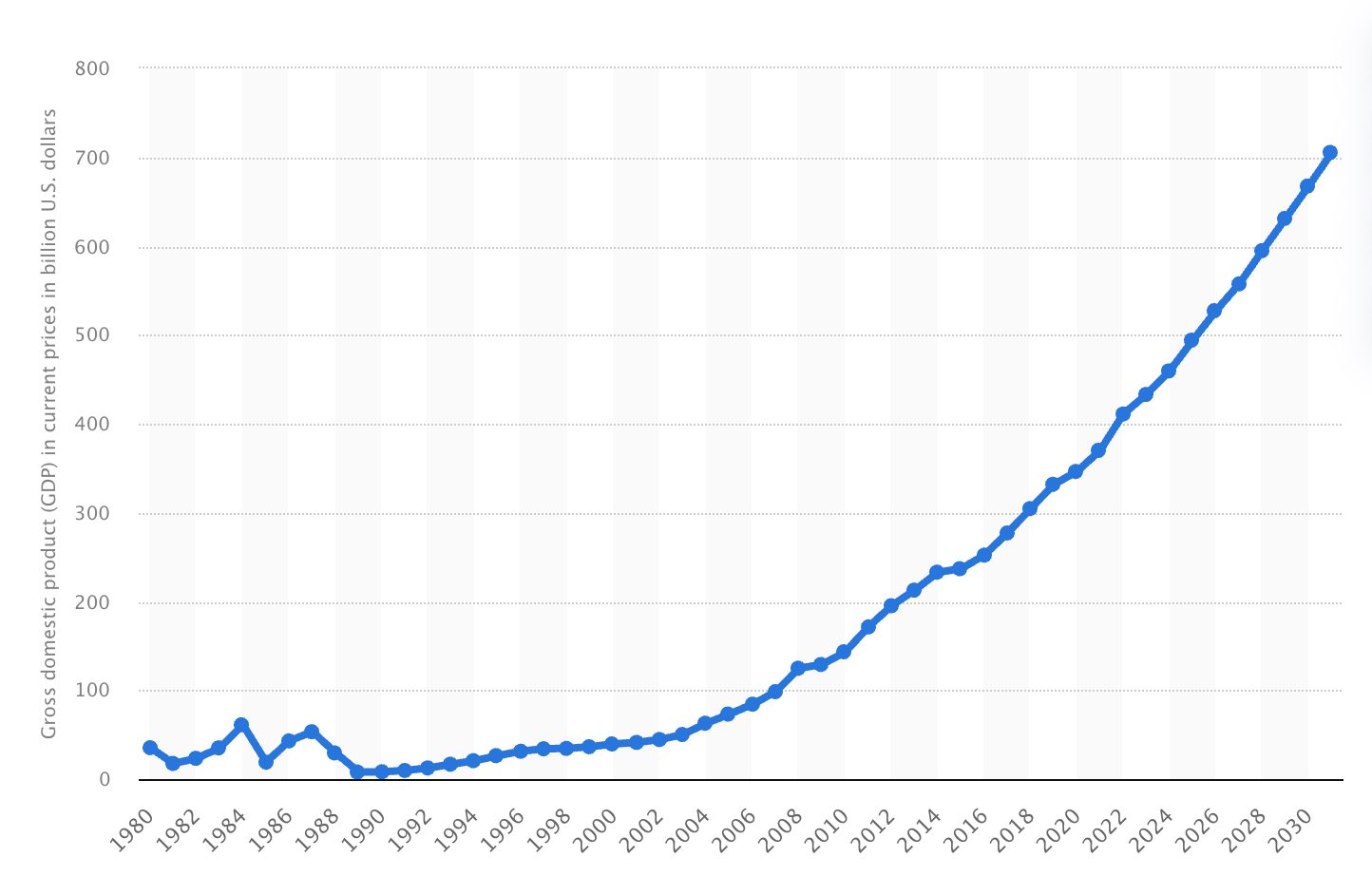
Gross Domestic Product (GDP) of Vietnam at current prices from 1980 to 2031 (in billions of US dollars). Source: statista.com
Vietnam is growing at an average rate of 6–8% per year — consistently, through crises, through COVID, through global slowdowns. By the end of 2025, GDP growth exceeded 8% — one of the best indicators in the world. For comparison: Thailand grew by 1.5–2%, Indonesia by 5%, China officially by 5%, but with growing structural problems.
This is not a sprint of a developing economy. It is a sustainable marathon of a country that is consistently integrating into global production chains.
An Export Machine. Vietnam is among the top 20 world exporters. Export volume grew from $72 billion in 2012 to $475 billion in 2025 — a sixfold increase in a decade. A 17% gain in the last year alone. Half of these exports are driven by high-tech goods: smartphones, semiconductors, electronics. The computers and electronics sector alone brought in $108 billion in 2025. Samsung produces every fifth smartphone in the world here. Intel, LG, Foxconn are here. Apple moved part of its AirPods and MacBook production here as well.
China+1 as a Structural Trend. Following the trade wars of 2018–2019 and COVID-related supply chain disruptions, Western corporations are systematically diversifying manufacturing away from China. Vietnam is the primary beneficiary of this process. The country offers a unique combination: a young and disciplined workforce, competitive labor costs, developed port infrastructure, and political predictability. In 2024, Vietnam ranked among the top three largest recipients of foreign direct investment in Asia among emerging markets.
FDI: $38.4 billion in registered investments in 2025. Meanwhile, actual implemented foreign investment grew by 9% to $27.6 billion, the best performance in five years. About 7% of this flow goes directly into the real estate sector — offices, residential complexes, industrial parks, and hospitality infrastructure. When such a volume of corporate capital enters the country, it pulls residential demand along with it: managers, engineers, technical specialists — all are needed on-site, and all of them rent or buy housing.
Demographics: Built-in Demand for Decades Ahead

The most long-term investment argument in favor of Vietnam is not economic policy or FDI. It is 97 million people with a median age of 30.
Peak Household Formation — happening right now. The generation born in the 1990s and 2000s is now entering the age of buying their first home. This is not a forecast — it is a demographic fact. Right now, in 2025–2035, Vietnam is passing the peak of domestic housing demand. No economic policy can create such demand artificially — it is either there or it isn't.
The Middle Class is Doubling. According to McKinsey forecasts, by 2030, Vietnam's middle class will double — from approximately 33 to 65–70 million people. This is one of the fastest rates of wealth growth in the world. A growing middle class means not only demand for housing, but demand for higher quality housing: transitioning from renting to ownership, and from ownership to a higher class of property.
Urbanization is Incomplete. Currently, about 40% of Vietnam's population lives in cities. In China, this figure exceeds 65%, in South Korea — 82%. Every percentage point of urbanization represents roughly 1 million people moving from rural areas to cities. This process will continue for at least another 15–20 years, constantly feeding the demand for urban housing.
These three factors — age peak, wealth growth, and incomplete urbanization — are working at the same time. This is a rare combination.
Geopolitics: Neutrality as an Investment Advantage
In a world where sanctions, trade wars, and geopolitical blocs are fragmenting investment flows, Vietnam occupies a unique position.
Strategic Partner to All UN Security Council Members. Vietnam is the only country in the world that holds a "comprehensive strategic partnership" status with all five permanent members of the UN Security Council: the US, China, Russia, the UK, and France. With the United States, this partnership was elevated to the highest level in September 2023 during Biden's visit. This is not a diplomatic formality — it is insurance against sanction and geopolitical risks.
"Bamboo Diplomacy" Policy. For decades, Vietnam has been building relationships with all major players, avoiding taking rigid sides. The country is not under sanctions from any significant market. There are no external currency restrictions. There are no political risks comparable to Russia, Belarus, or Myanmar.
Extensive Network of FTAs. Vietnam has signed more free trade agreements than most countries in the world: CPTPP (with Japan, Canada, Australia, Mexico, and others), EVFTA with the EU, RCEP with China and ASEAN. These are not just economic treaties — they are an architecture of trust, an integration into global rules of the game.
For an investor, this means: the risk of asset freezes, restrictions, or discriminatory policies against foreign capital here is significantly lower than in most other emerging markets.
Political Stability: Predictability as an Asset
Vietnam's single-party system often raises questions among Western investors. But from the point of view of the capital market, it has a concrete consequence: political continuity.
Over the last 30 years, Vietnam has not experienced a single revolutionary coup, a single shift in economic course, or a single nationalization of foreign assets. The economic course — gradual liberalization, attraction of foreign capital, integration into world trade — is implemented consistently regardless of changes in specific leadership.
For a long-term real estate investor with a 7–15 year horizon, this is critical. Markets with high political volatility (Thailand, Myanmar, parts of Latin America) require a political risk premium. Vietnam eliminates this risk.
Infrastructure: The State is Building the Market
Vietnam invests about 7% of its GDP in infrastructure annually — one of the highest rates in the world. For comparison: the ASEAN average is around 4%, and the average for developed countries is 2–3%.
This is not an abstract figure. It materializes in concrete facilities that directly affect real estate prices:
Ho Chi Minh City: Metro Line 1 launched in 2024, Line 2 is under construction with commissioning in 2030, Ring Road 3 is operational, Ring Road 4 is under construction (commissioning 2028). Every new transport artery opens new investment zones and revalues surrounding real estate.
Long Thanh Airport — the country's largest infrastructure project valued at $16 billion, with a designed capacity of 100 million passengers per year. Phase one — 2026–2027. This will create a new growth pole east of Ho Chi Minh City and radically change the accessibility of the region for international tourists and business travelers.
Da Nang and Nha Trang: expansion of international airports, new coastal highways, development of port infrastructure.
Binh Duong and Ba Ria-Vung Tau: inclusion in the expanded Ho Chi Minh City metropolitan area means direct state investment in transport connectivity — something that traditionally precedes land price growth in nearby suburbs.
The link between state infrastructure investment and real estate prices is well-documented: first a road or metro is built — then everything around it is revalued. In Vietnam, this process is happening on a nationwide scale right now.
Legal Reform 2024: New Rules for Foreign Investors
2024 was a turning point for the legal framework of the Vietnamese real estate market. Three laws came into force simultaneously, systematically changing operating conditions: the new Land Law, the Housing Law, and the Real Estate Business Law.
What Has Changed for Foreign Investors:
Mandatory Developer Insurance. Developers are now required to hold insurance coverage for projects at the construction stage. This protects buyers from project freezes — a key risk that materialized during the 2022–2023 crisis.
Transparent Ownership Confirmation. The Pink Book (Certificate of Ownership) for foreigners has become more straightforward to obtain. Project verification procedures to ensure compliance with sales-to-foreigners requirements have been standardized.
Regulation of Deposits and Payment Schedules. The law limits advance payments and regulates escrow-like mechanisms, reducing the risk of developer abuse.
Clarification of Ownership Terms. Foreigners received a clearer regulatory framework: 50-year ownership rights with renewal options, inheritance rights, and the right to sell to third parties (including other foreigners).
These changes were a direct response to the 2022–2023 crisis, when several major developers faced bankruptcy due to corporate bond schemes. The market passed a stress test; the regulator identified weak spots and fixed them. This is mature market behavior.
Currency and Banking System
The Vietnamese Dong (VND) is a managed currency whose exchange rate the State Bank of Vietnam keeps within a predictable range relative to the US dollar. Over the last decade, the VND has lost about 20% against the USD — less than 2% per year, which is one of the best metrics among emerging market currencies in the region.
Vietnam's banking system underwent significant consolidation following the 2022–2023 crisis. The regulator (SBV) is consistently raising bank capital requirements and balance sheet transparency. For a foreign investor, this means a more reliable environment when dealing with local bank accounts and foreign exchange transactions.
Market Track Record: What Happened in 10 Years
Vietnam's real estate market is not a theory or a forecast. Over the last decade, it has shown concrete results.
Capital Growth. Prices in prime areas of Ho Chi Minh City increased by 150–200% over 10 years.
Thu Thiem: $5,000/m² in 2017 → $10,000–11,000/m² in 2024.
Eastern Corridor (Thu Duc): $1,500/m² in 2015 → $4,000–5,500/m² today.
These are not isolated fluctuations — this is a systematic market revaluation of the country's new economic reality.
Rental Yields. In the quality residential segment — 4–6% net in Ho Chi Minh City, 5–7% in Da Nang. In the hospitality segment in Phu Quoc — up to 8% net with a professional management operator.
The 2022–2023 Crisis and Its Lessons. The market is not immune to shocks. In 2022–2023, several large developers faced liquidity crises amid tighter corporate bond regulations. Some projects were frozen, and the secondary market temporarily lost liquidity. It was a real stress test. The market passed it: weak players left, the regulator introduced reforms, and demand returned. 2024–2025 is a period of recovery and a new growth cycle.
An investor entering in 2024–2025 comes in at the start of a new cycle following market cleansing. Historically, this is one of the best entry points.
Vietnam vs. Competitors
| Parameter | Vietnam | Thailand | Cambodia | Indonesia | UAE (Dubai) |
|---|---|---|---|---|---|
| GDP Growth | 6–7% | 1.5–2% | 5–6% | 5% | 3–4% |
| Ownership Type | 50 years with extension | Freehold (condo, 49%) | Strata title (freehold) | No direct ownership | Freehold in designated zones |
| Foreign Quota | 30% of building | 49% of building | No quota | Nominee only | No quota |
| Rental Yield | 4–8% | 4–6% | 6–8% | 4–5% | 5–8% |
| Political Stability | High | Medium | Medium | High | High |
| Sanctions Risk | None | None | Low | None | Present for select nationalities |
| Demographic Potential | ★★★★★ | ★★★☆☆ | ★★★☆☆ | ★★★★☆ | ★★☆☆☆ |
| Market Transparency | Medium → Growing | High | Low | Medium | High |
Key Comparison Takeaways:
vs. Thailand: Bangkok is a mature market with low organic growth. Vietnam offers a fundamentally different demographic and economic dynamic with comparable transparency.
vs. Cambodia: Full freehold is attractive, but the market is small, secondary market liquidity is very low, and the legal base is weaker. Vietnam is more reliable with less legal risk.
vs. Indonesia: Direct ownership for foreigners is effectively non-existent. Nominee schemes carry legal risks. Vietnamese 50-year ownership rights with extension options provide a much safer instrument.
vs. UAE: Dubai is a saturated market with high supply competition. Vietnam is a market at the beginning of its cycle. Plus, Dubai carries specific geopolitical risks for certain nationalities.
Why Right Now, Not in Five Years
This is a question asked by every second investor. The answer is non-obvious, but concrete.
The Market Has Cleared. The 2022–2023 crisis swept away weak developers, shady bond schemes, and opaque projects from the market. The remaining players passed the stress test. Entering a cleared market means working with lower counterparty risk.
The Legal Framework Has Been Updated. Three reform laws of 2024 — the Land Law, Housing Law, and Real Estate Business Law — have come into force. An investor in 2025–2026 receives protections that buyers in 2019–2021 did not have.
Infrastructure is Not Yet Priced In. Metro Line 2 is nearing completion, Ring Road 4 is under construction, and Long Thanh Airport will be commissioned in 2026–2027. Property revaluations along transport corridors occur before construction completes — not after. Those who wait for the opening end up paying an already revalued price.
The HCMC Conurbation is Just Forming. The inclusion of Binh Duong and Ba Ria-Vung Tau into the expanded Ho Chi Minh City conurbation is a 2025 administrative decision with long-term price implications. The market has not fully played out this fact yet.
Foreign Participation is Limited — For Now. The 30% foreign ownership quota per building and the 50-year horizon create an artificial deficit for non-residents. In high-demand projects, the quota fills up quickly. Those who enter now pick the best units. Those who wait take the leftovers or overpay on the secondary market.
GDP Grew 8%+ in 2025. Following a period of reform and consolidation, the economy accelerated. This is not a post-COVID rebound — it is the new operating pace of a country integrated into global manufacturing and export chains.
The window is not closed. But it will not remain open forever.
Conclusion
In 2026, Vietnam offers a rare combination: a high economic growth rate, built-in demographic demand, geopolitical neutrality, and a reformed legal base. It is neither a frontier market with exotic risks nor a mature market with low yields. It is a market at the start of a long cycle backed by fundamental factors.
The question is not whether to look at Vietnam. The question is in which city and with what strategy. If you want to figure this out with respect to your goals — schedule a consultation.
*Sources: World Bank, IMF, CBRE Vietnam, Savills Vietnam, McKinsey Global Institute, State Bank of Vietnam, Ministry of Construction of Vietnam, Vinprop Research.
FAQ
Is it safe to invest in Vietnam?
It is safe with the right choice of project, developer, and legal support. Risks exist — as in any market. The main ones include selecting an unreliable developer, a project without clear approval for sales to foreigners, or lack of Pink Book verification. All of these risks are manageable with a professional partner.
Can a foreigner really own property in Vietnam?
Yes — under the 2015 Housing Law and its subsequent amendments. A foreigner receives a Pink Book — property ownership rights for 50 years with a renewal option. This is a full-fledged ownership right with the ability to rent out, sell, or inherit.
What is the minimum entry budget?
From $55,000–80,000 in the entry-level segment (Nha Trang, Binh Duong). In Ho Chi Minh City, a quality property starts from $120,000–150,000. The recommended budget for a liquid asset is $150,000–250,000.
Is physical presence required for the transaction?
Yes — personal presence is mandatory when signing the sale and purchase agreement. Vietnamese law requires the physical signature of the buyer. This is also a good opportunity to inspect the object, district, and city before making a final decision.
How to exit an asset?
By selling to another foreigner or a local buyer. The secondary market in Ho Chi Minh City is the most liquid in Vietnam. In resort markets (Phu Quoc, Nha Trang), liquidity is lower — this should be factored in upon entry.
Why now, instead of waiting?
The recovery cycle following 2022–2023 has just begun. The 2024 reforms created a cleaner regulatory environment. Major infrastructure is being launched in 2026–2030 — property revaluations happen before commissioning, not after. Waiting means entering at a higher price.